This is Milliman’s second annual projection of U.S. long-term care insurance (LTCI) industry claims. Since our inaugural 2025 report,1 the market has continued to evolve. The standalone LTCI block remains in run-off at most carriers, yet 2025 brought unexpected activity: new product filings from insurers reentering the space and sustained policy sales growth in hybrid life/LTCI as baby boomers age into their highest-risk years. This projection continues to focus on the run-off of legacy standalone blocks. However, as new standalone and hybrid LTCI sales gain momentum, future iterations of this analysis will need to incorporate emerging cohorts and their distinct risk profiles. We show in Figure 1 the expected benefits (paid claims) that long-term care (LTC) insurers will provide over the remaining life of the policies as of year-end 2024. We did not model future new sales of LTCI (including future purchase options), and we did not model hybrid life and LTCI business.
Figure 1: Expected future U.S. LTCI paid claims (millions)
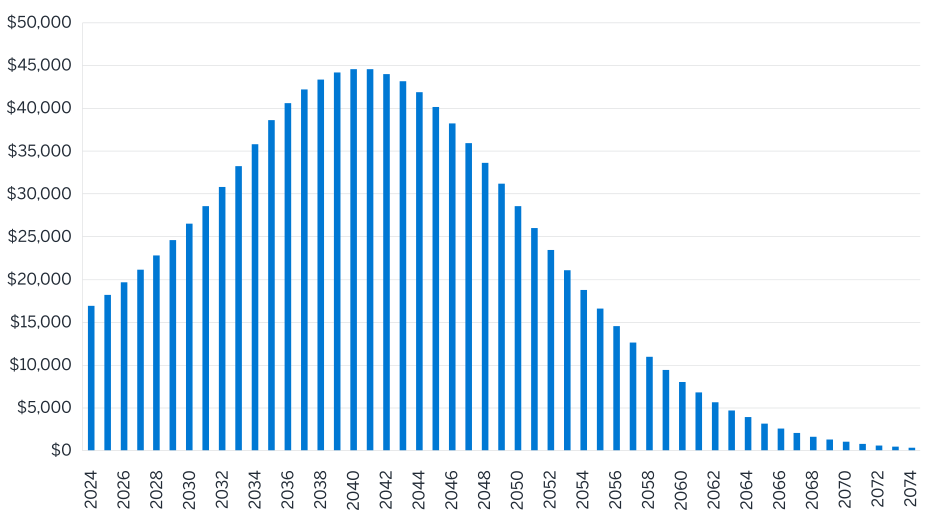
The National Association of Insurance Commissioners (NAIC) reported LTCI incurred claims of approximately $17 billion in 2024.2 We forecast an increase in LTCI paid claims through about 2041, with a peak of paid claims of $44 billion (see Figure 1). This projection is based on the latest available data and is slightly higher than our previous projection3 due to changes in the assumptions for the underlying distribution of business. Liability assumptions remained the same. Since we did not include new sales estimates, the projection of paid claims declines over the remaining decades, reflecting the aging of the in-force population. We assumed that historical paid claims were similar to reported incurred claims for the purpose of our dynamic validation.
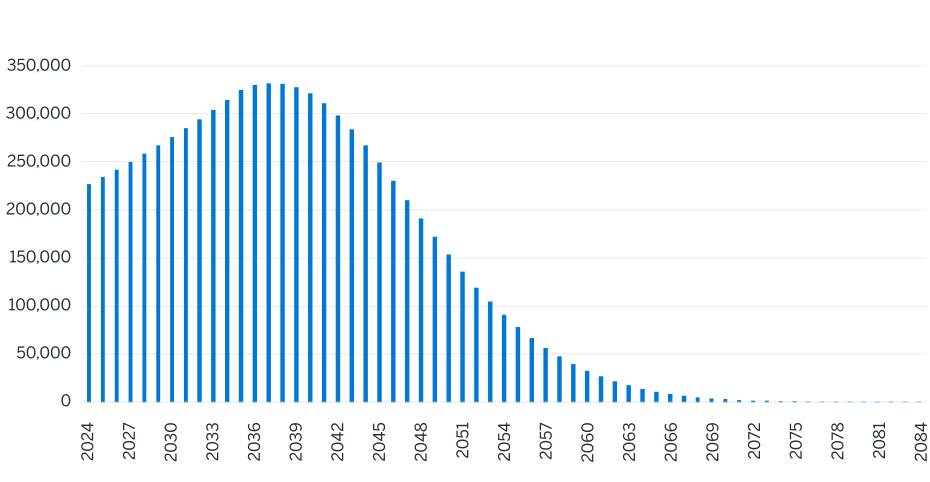
We also projected policies expected to be on claim with a peak of 332,000 expected in 2037 (see Figure 2).
Figure 2: Expected future U.S. LTCI claimants
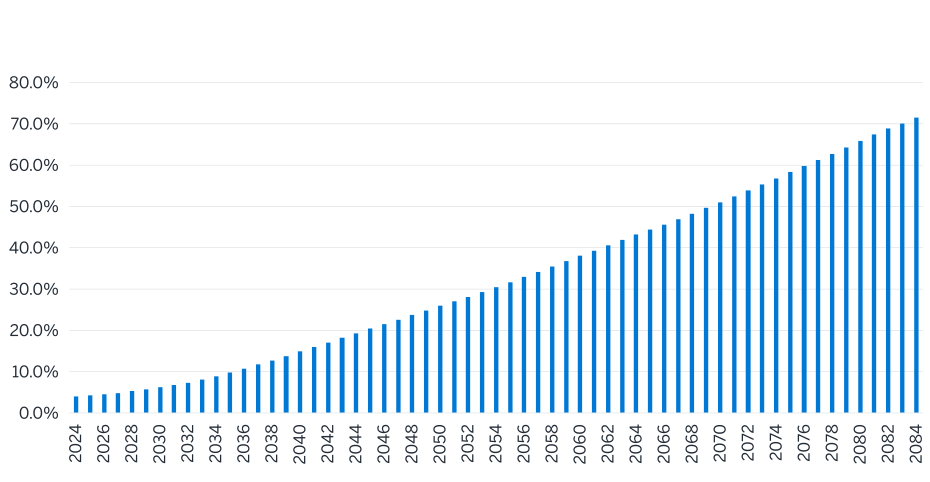
Claims as a percentage of the block are expected to grow over time. Because this is a projection of run-off business, the block of business ages over time. Thus the portion of policies on claim rises as the population reaches older ages, consistent with our actuarial assumptions (see Figure 3).
Figure 3: Expected future U.S. LTCI claimants as a percentage of all policies
We used a first-principles actuarial projection model. We combined our understanding of the current nationwide LTCI policy base with our expectations of mortality, voluntary lapse, and morbidity (claim incidence and severity) to project paid claims for this exercise. The sections below provide further details of the model and assumptions. The actual future mix of policyholders (by policy type and demographics) will almost certainly be different from what we’ve assumed here.
Assumptions and methodology
Projection model
We built a first-principles model in Milliman’s proprietary Integrate software (powered by the MG-ALFA calculation engine and formula database). The software’s standard calculation logic allows for separate modeling of claim incidence, utilization, claim recovery rates, and mortality (including separate modeling of active and disabled life mortality). All assumptions were modeled on a first situs of care basis.
We assumed a starting claim reserve of approximately $47 billion at December 31, 2024, and projected paid claims covered by this reserve. To smooth the initial claims in our projection we interpolated paid claims between 2024 and 2035. This was important given our methodology of bucketing attained ages at the valuation date and that applying the mix of new incurrals and existing paids produced discontinuity in the projection. The smoothing did not materially change our incidence rate projection.
Distribution of business
We assumed the following mix of business, for roughly 5.6 million LTCI policyholders at December 31, 2024. These assumptions are based on NAIC reported results and our experience. We used this as the in-force input for our projection. As we do not know the exact underlying distribution, this may change in future years as we are able to calibrate actual to projected. This accounts for small differences seen in the projection from one year to the next. This year we also projected disabled lives (as of December 31, 2024) using a first-principles approach. We used the following distribution for active lives. For disabled lives, we used a distribution that would calculate a starting number of $47 billion.
- Average attained age at year-end 2024 of 72 (active) and 84 (disabled)
- Male (36.6%) / female (63.4%)
- Issue year buckets:
| Issue Year | Active Lives |
|---|---|
| 1990 | 0.0% |
| 1995 | 3.0% |
| 2000 | 22.1% |
| 2005 | 29.8% |
| 2010 | 31.5% |
| 2015 | 6.1% |
| 2020 | 7.5% |
- 5% compound for life inflation (50%) / no inflation (50%)
- Reimbursement (85%) / indemnity (15%) / cash (none)
- Married at issue (60%) / single at issue (40%)
- Benefit period: 3 year (70%) / lifetime (30%)
- Elimination period: all 90-day
- Policy type: comprehensive
- Tax-qualified status for all policies
- Original daily benefit amount: $225 (noninflation) / $150 (inflation)
- Assumed issue age and underwriting distribution that produced a projected incidence rate consistent with historical incidence rates from NAIC LTC Experience Reporting Form 14
Morbidity assumptions
We modeled incidence, utilization, and claim continuance assumptions.
Morbidity assumptions are for the most part based on the 2023 Milliman Long-Term Care Guidelines. The 2023 Guidelines are based primarily on claims from 2010 through 2019 to include most recent relevant experience. We gave consideration to the experience during the COVID-19 pandemic in 2020 and 2021, but did not directly use this experience for assumption setting. The primary 2010–2019 study period for the 2023 Guidelines includes roughly 460,000 claims and 30 million life years of exposure and represents experience from 18 of the top 25 LTC insurers (based on lives in force). The inception-to-date dataset includes 1.1 million claims and 82 million life years of exposure. This significant amount of data makes the Guidelines a credible baseline for developing morbidity assumptions. The general approach to updating the Guidelines is to analyze how recent experience aligns to the prior set of Guidelines. The 2023 Guidelines used predictive analytics to update the assumptions, including the development of incidence, claim termination (disabled mortality and recovery), and transfer rates.
- Incidence: We used incidence rates from the 2023 Milliman Long-Term Care Guidelines.
- Utilization: We assumed a starting utilization for skilled nursing facilities (SNFs) and assisted living facilities (ALFs) of 95% and a starting utilization for home healthcare (HHC) of 67% for reimbursement policies.
- Future cost of care: For facility care (both ALF and NH), we used a 4% cost of care inflation and 100% days utilization. For home care, we used a 3% cost of care inflation and 70.5% days utilization. For all three situses, we used 95% dollars utilization and floored future utilization at 10% less than starting utilization.
- Continuance: This is related to how long a claim will persist. Typically, this varies by lifetime or nonlifetime benefit period and gender. We used continuance rates that vary by starting care situs from the 2023 Guidelines. The Guidelines’ continuance curves are also split into disabled life mortality and recovery rates used in our model.
- Underwriting selection factors: Selection factors were applied to the morbidity basis to reflect the effect of underwriting and the method of issue. The Guidelines’ selection factors vary by underwriting level (i.e., tight, moderate, or loose), the method of issue (i.e., full underwriting or guaranteed issue), issue age, gender, and marital status. Our research5 has shown that there is significant difference in morbidity by marital status due to a partner being able to help administer care at home. This difference wears off over time as divorces and deaths of spouses occur.
Policy termination rates
The mortality and lapse assumptions are based on industry experience. Our projection model reflects that a policyholder can terminate their policy under three scenarios: death, voluntary lapse, or benefit exhaustion.
- Deaths: We selected the 2012 individual annuity mortality (IAM) table based on industry trend. Since we are using a first-principles model, we used scalars to convert from total mortality to active life mortality. These scalars are based on internal Milliman research. Disabled life mortality is consistent with the 2023 Guidelines.
- Lapse: Most companies in the industry see an ultimate voluntary lapse rate of around 0.5% to 1.5%. We chose an ultimate lapse rate of 1.0% starting in duration 5.
- Benefit exhaust: This is based on when a given claimant with nonlifetime benefits is expected to use up their benefits based on their policy design and utilization assumptions. The projection model tracks accumulated claim payments/service days to calculate benefit exhausts within the model.
Ancillary benefits or paid-up policies
We did not explicitly model ancillary benefits directly (we assume they are reflected in the final true up of paid claims). We did not model any paid-up policies or nonforfeiture benefits.
Caveats and limitations
The attached results are based on Milliman research and on our experience in working with LTCI carriers. Actual experience will vary from our estimates for many reasons, including differences in policy design such as benefit periods, elimination periods, reimbursement levels, policyholder demographics, geography, and the delivery of healthcare services, as well as other nonrandom and random factors. It is important that actual experience be monitored and adjustments made as appropriate. Our estimates are not predictions of the future; they are estimates based on the assumptions. If the underlying data or other listings are inaccurate or incomplete, this analysis may also be inaccurate or incomplete. Emerging results should be carefully monitored, with assumptions adjusted as appropriate. Our analysis is based on historical practice patterns and treatments that may change over time.
Milliman has developed certain models to estimate the values included in this report. The intent of the models is to project future LTC paid claims. We have reviewed the models, including their inputs, calculations, and outputs for consistency, reasonableness, and appropriateness to the intended purpose and in compliance with generally accepted actuarial practice and relevant actuarial standards of practice (ASOP).
Milliman does not intend to legally benefit any third-party recipient of its work product. Even though Milliman has consented to the release of its work product to a third party, any third-party recipient of this report should not rely upon Milliman’s report, but should engage qualified professionals for advice appropriate to its own specific needs. The statements contained in the report are those of the authors and do not necessarily represent the views of Milliman or its other consultants.
We, Rachel Marsiglio, Juliet Spector, and Robert Eaton, are members of the American Academy of Actuaries and meet its Qualification Standards to provide this statement of actuarial opinion.
1 Marsiglio, R., Spector, J., & Eaton, R. (2025, March 6). Milliman’s annual U.S. industry LTCI claims projection [White paper]. Milliman. Retrieved March 3, 2026, from https://www.milliman.com/en/insight/annual-us-industry-ltci-claims-projection-2025.
2 Smetek, S., Gunnlaugsson, A., Giese, C., & Clemens, Q. (2025, December 31). The long-term care insurance industry through 2024: Summary statistics and observations from the Experience Reporting Forms [White paper]. Milliman. Retrieved March 3, 2026, from https://www.milliman.com/en/insight/ltci-2024-statistics-experience-reporting-forms.
3 Marsiglio, R., Spector, J., & Eaton, R., op. cit.
4 National Association of Insurance Commissioners. (2025). Long-term care insurance experience reports for 2024. Retrieved March 3, 2026, from https://content.naic.org/sites/default/files/publication-ltc-lr-care-experience-report.pdf.
5 Schmitz, A., Yeager, A., & Hamilton, J. (2019, November 22). Is your spouse contagious? Milliman. Retrieved March 3, 2026, from https://www.milliman.com/en/insight/Is-your-spouse-contagious.